

Tuesday’s program at the 41st Mar del Plata International Film Festival centered on Espacio Chauvin and included an emotional tribute to Luis Brandoni through “Parque Lezama”.
The 41st Mar del Plata International Film Festival had an intense Tuesday, marked by local protagonism, debates on new production models, international presence, and shared emotion.
Early in the afternoon, the Asociación de Cronistas Cinematográficos de la Argentina (ACCA) arrived at Chauvin to announce the winners of the 2025 Cóndor de Plata Awards. The ceremony, hosted by journalists Emiliano Basile and Javier Luzzi, opened with the presentation of the Leonardo Favio Lifetime Achievement Award to filmmaker, educator, and researcher Miguel Monforte — a Mar del Plata native and key figure in collective memory documentary filmmaking and local archive preservation through his work at the Museo Barili and films such as Héroe corriente.
With the humility that defines him, Monforte expressed his gratitude upon receiving the award in his hometown ahead of the formal ceremony at the end of the month in Buenos Aires: “These are the kinds of things where, day to day, you don’t know what you’re planting — and in the end, what you’ve done wasn’t so bad.” The filmmaker thanked the “enormous number of people who helped me and continue to help me,” and defined the guiding principle of his vocation: “Beyond loving film, my goal is to not waste people’s time — so that when someone watches something I made, they leave the room having learned something.”
The 2026 Cóndor de Plata winners were then announced, hosted by Paula Corruega and Leo Damario.
The panel discussion “New Forms of Production,” led by Damario and moderated by Agustín Pallares and Alejandra Grimaldi, addressed the aesthetic and financial transformations of the digital era.
Damario — a standard-bearer of independent auteur cinema and director of iconic music videos for artists such as Andrés Calamaro and Babasónicos — argued for the need to expand the limits of the traditional format: “We need the film project to be something bigger than the film itself. A film has to be many more things — it’s a business model very similar to the work that used to be done in advertising.”
Speaking directly to young creators, he issued a generational challenge: “I tell students they need to think about how to smuggle their art bombs into these formats that have constant serialization across new platforms and technologies. We need to understand movie theaters as promotional situations for the total body of work, and to place the film in the social conversation — but through a broader path. We can’t ignore new forms of communication or new forms of filmmaking.”
Carlos Cuarón and the Spark of Cinema
Chauvin’s closing act was Mexican screenwriter and director Carlos Cuarón (Y tu mamá también, Rudo y Cursi), who gave an open talk full of freshness, humor, and reflections on screenwriting and the Latin American market.
Looking back on his beginnings and his earliest calling, Cuarón drew laughs from the audience as he recalled the turn his life took when he moved into filmmaking: “I studied English literature because I’d become passionate about it — it was going to teach me to analyze texts and help me write. At the time I saw myself as an intellectual, writing novels, having cocktails at embassies… but it was because of my bastard brother [Alfonso Cuarón] that he introduced me to this whore called cinema, and I’m very easy.”
The Mexican writer explained how that decision reshaped his career: “I finished university and I saw more of a future in film than in academia, at a time when no movies were being made in Mexico.”
Parque Lezama at the Villa Victoria Gardens
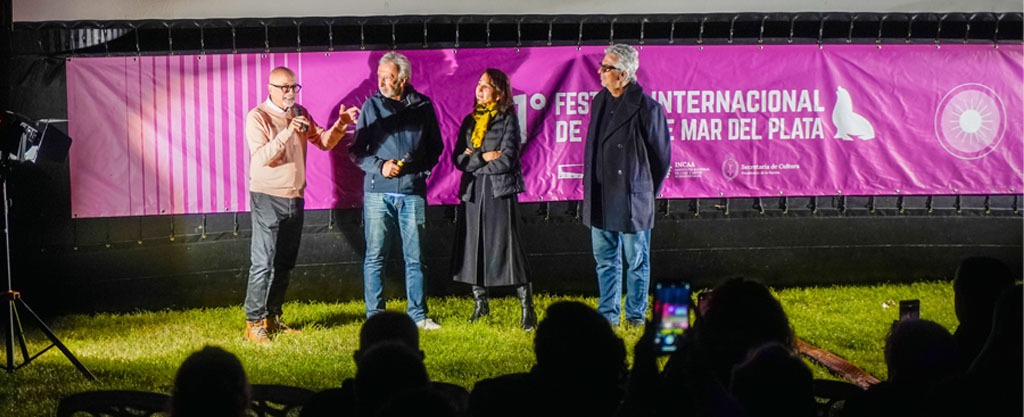
The day also made room for deep emotion in celebrating the life and legacy of Luis “Beto” Brandoni through the world of Parque Lezama, the film screened as part of the free 8:00 pm outdoor program at Villa Victoria Ocampo.
During the gathering, Saula Benavente, Beto’s life partner, recalled Brandoni’s determination to bring the project to life: “The way he pushed for it to get made… He’d call Eduardo to convince Juan [Campanella]. A month after the play opened, he already wanted to make it into a film.”
For his part, Eduardo Blanco shared his emotion at returning to the festival with this tribute: “It’s a special night, almost magical. Being in this place stirs something in me — the last time I was here was when we came with the play and received the Vilchez Award, with Beto and the whole cast. I’m moved that this is a communal event, watching the film and feeling that we can be moved and laugh at the same things together. I’m certain that Beto is here with us somewhere, and that he’ll be able to enjoy this night.”
Finally, composer Emilio Kauderer described how the actors’ performances inspired the film’s score: “Beto and Eduardo inspired me. The acting was so moving that I kept adding to it.”